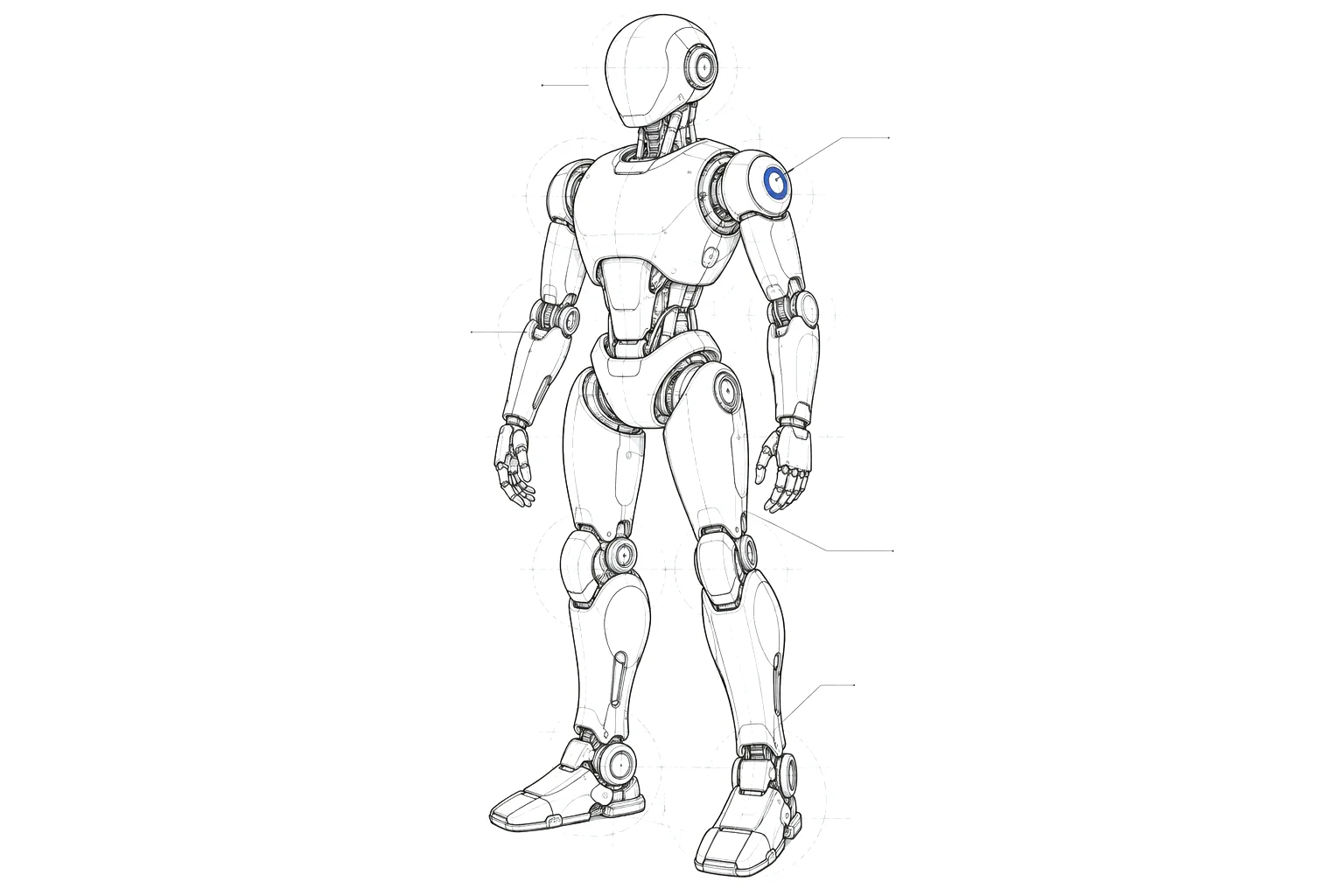
A Unitree G1 uses its torso to carry a box. It is still research.
A new sim-to-real controller reports controlled, teleoperated Unitree G1 trials that brace a basketball or box against the robot’s body, not a home-ready household assistant.
The controller operates interactively, steered by coarse motion references from a human teleoperator.Whole-Body Dexterity authors, arXiv abstract
The result
A new Whole-Body Dexterity paper reports a useful-looking but tightly bounded result: a Unitree G1 can use more than its hands to move objects. The researchers train a controller to brace and reposition a basketball and a 15-centimeter cardboard box across the robot’s arms and torso. In one longer demonstration, the G1 picks a box from a shelf, tucks it under one arm, carries it to a table, and puts it down.
That is a research result, not a product announcement. The system is demonstrated on one robot in controlled trials, and a skilled person remains in the loop. It does not show a consumer robot independently finding household objects, deciding how to handle them, or working reliably through a cluttered home.
The paper’s central idea is sensible. People often carry objects by using a chest, forearm, shoulder, or torso as an extra contact surface. A humanoid that only grips with its fingers gives up those options. The authors call the alternative whole-body dexterous manipulation: deliberately changing the places where an object contacts the body while moving it.
How it works
The research pipeline begins in simulation. It generates a dataset of stable ways for an object to touch different regions of the robot’s body, then trains reinforcement-learning specialists to move objects between those positions. Those specialists are distilled into one policy that takes the robot’s proprioception and object geometry as inputs. The authors then transfer that controller to a physical G1 without task-specific retraining.
The physical setup matters as much as the controller. According to the project page, all trials use one skilled teleoperator in an Xsens motion-capture suit. The operator supplies upper-body motion commands, while another controller handles the lower body. The paper says, “The controller operates interactively, steered by coarse motion references from a human teleoperator.” That is not a hidden footnote; it is a boundary on what the demo establishes.
The reported comparison is strong within that setup. Across the real-world whole-body manipulation tasks, the paper reports 45 successful trials out of 50 for its distilled controller, versus 9 out of 50 for direct motion retargeting and 2 out of 50 for its generalist baseline. On the project page, the underarm-stow test with the cardboard box reaches 10 of 10 trials for the proposed controller. Those figures describe the authors’ selected tasks and conditions, not an estimate of household reliability.
What it means for a home robot
Home work regularly involves awkward objects: a laundry basket against the hip, a package held to the chest while opening a door, or a box carried from a shelf. A humanoid that can safely use its torso and arms as support surfaces could need fewer perfect fingertip grasps and fewer handoffs. That could make carrying bulky, light objects more practical.
This work also shows why a short video of a humanoid carrying something needs context. The G1 did not simply receive a verbal household instruction and solve the entire problem. Its object geometry was part of the controller input, the tasks were designed for the experiment, and a teleoperator provided coarse upper-body guidance. The reported shelf-to-table sequence is a meaningful integration test, but it is not evidence that the system can operate unattended in a home.
Unitree’s G1 remains a research and developer platform in this story. The paper is about a capability layer tested on that hardware, rather than a change in the robot’s availability or household status.
Caveats
The study covers two simple object types: a basketball and a 15-centimeter cardboard box. They are useful tests because they require changing support contacts, but they do not stand in for a basket of laundry, a fragile dish, a pet underfoot, or a moving person nearby. The reported long-horizon task also remains structured: shelf, box, table, and a known sequence.
The authors’ test counts are small. Their 90 percent headline is 45 successes in 50 real-world trials, and the comparison baselines are evaluated in the same experimental frame. Independent replication, more varied objects, recovery from slips, and safety testing around people would all be needed before this becomes a home-robot claim.
For now, Whole-Body Dexterity is a clear lab demonstration of a useful manipulation idea. It expands what a G1 can do under teleoperated, controlled conditions. It does not turn the robot into a household helper you can leave alone with the next delivery box.
We labeled this story Research — A lab result, not a product. How we label claims
Sources
- Whole-Body Dexterity — arXiv15 Oct 2026
- Whole-Body Dexterity project page15 Oct 2026