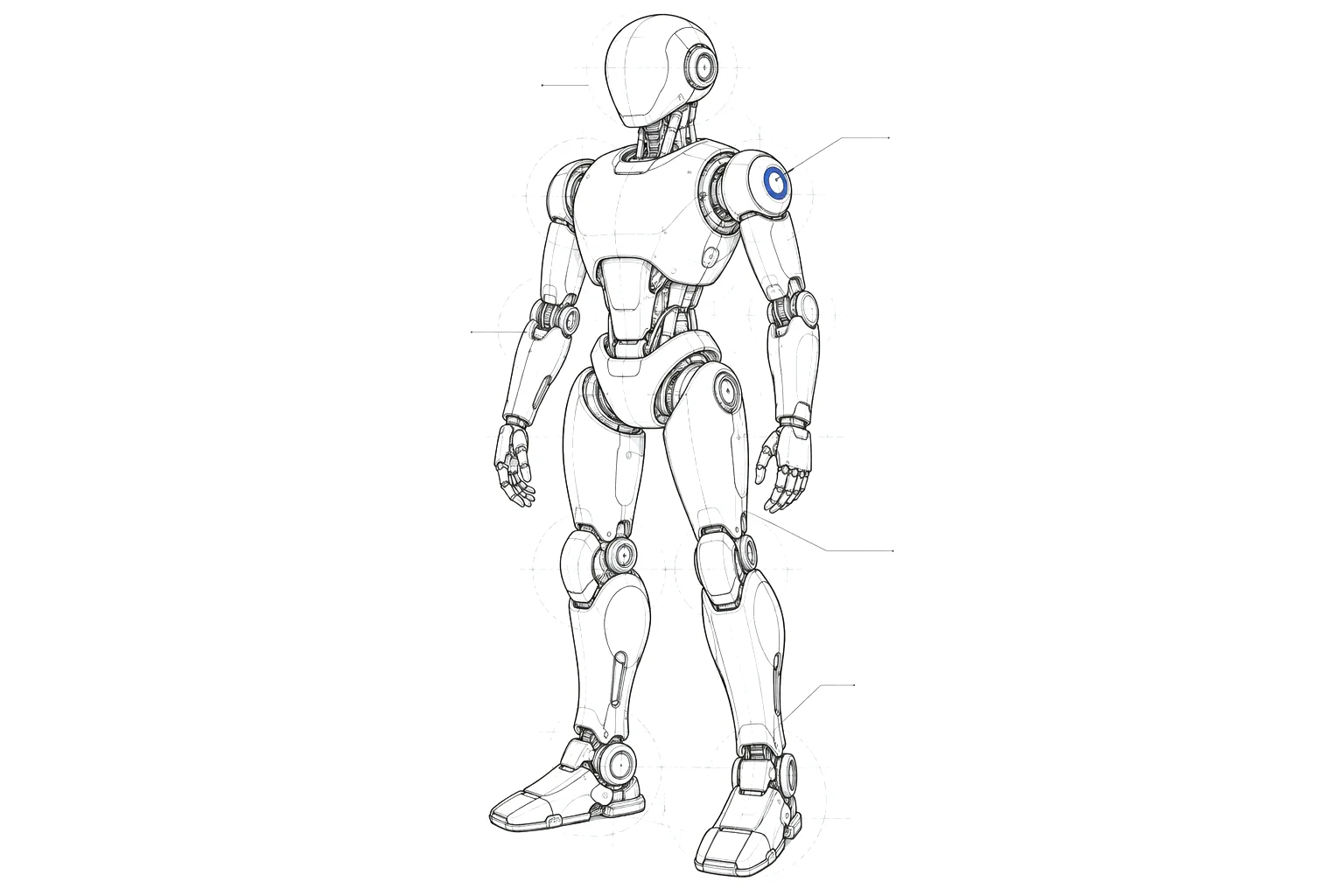
A Unitree G1 learns to react to people. It is still research.
Social Humanoid uses RGB-D video and 260 hours of retargeted interaction data to make a Unitree G1 respond to a human partner, but the result is not a household safety system.
Social Humanoid lets a humanoid perceive, anticipate, and respond to the people around it, from handshakes and high-fives to hugs, waves, and bows.Social Humanoid project page, Maluleke et al.
The result
A household humanoid will eventually have to do more than avoid people. It will need to notice a hand offered for an object, keep out of the way when someone changes direction, and behave predictably when it works near a person. A research group from UC Berkeley, Sony Group Corporation, and Meta has posted a system called Social Humanoid that tackles a narrow piece of that problem: generating a Unitree G1 robot’s whole-body response to a nearby human. The arXiv record lists the work as robotics research, not a product announcement.
The researchers report a hierarchy that takes live RGB-D video of a person, reconstructs their motion, predicts a compatible robot response, and passes that response to a whole-body controller on a 29-degree-of-freedom G1. The examples are social and physical interactions: handshakes, high-fives, hugs, waves, bows, posing together, and assisted motions. The project page says the system was evaluated in simulation and on hardware.
That is a meaningful change from the usual solitary humanoid demo. It is not evidence that a G1 can safely work around an unscripted family, or that it understands a person’s intent. It is a research result on responsive motion.
How it works
The central obstacle is training data. Human motion capture contains many two-person interactions, but a human body and a humanoid robot have different proportions, joint limits, and contact surfaces. The paper’s answer is a two-stage retargeting process. First, it maps one human participant’s movement to the robot while emphasizing joints that matter for contact. Then it adjusts the other person’s virtual body to the G1’s scale so that reach and contact relationships remain plausible.
The team says it used that process across five motion-capture datasets to build a Human–Humanoid Interaction benchmark with 260 hours and 28.1 million frames of paired interactions. The data include greetings, hugs, dances, assisted movements, and sparring-like motion. This is training material for coordinated movement, not a catalog of household chores.
At runtime, the system uses a high-level model to encode human and robot motion in a shared representation and generate the G1’s response. A lower-level tracking controller then executes the planned movement. The project page also describes shadow teleoperation, where a person’s motion can be mirrored by the robot. Those are different modes with a shared goal: make the robot’s body react in a way that stays coordinated with a person.
What it means for a home robot
Human-aware motion is a prerequisite for a credible home robot, particularly one meant to carry objects or work in rooms shared with children, older adults, and pets. A robot that can plan a route around furniture but cannot read the changing position of a person will be hard to trust at close range. The Social Humanoid result suggests one way to train responsive movement without recording every example directly on hardware.
The practical value is still far away from household autonomy. The reported interactions are structured motions, captured or staged for the study. They do not establish that the robot can interpret an ambiguous request, assess whether a hug or a handoff is welcome, handle a fragile object during contact, or stop safely after an unexpected shove. A real home adds occlusion, loose clothing, poor lighting, uneven floors, crowded rooms, and people whose behavior does not resemble a motion-capture set.
There is also a distinction between moving in coordination with a person and working with one. A home assistant needs task understanding, object perception, planning, grasping, and safety systems alongside responsive body control. Social Humanoid addresses only one layer.
Caveats
This is a CoRL 2026 paper posted to arXiv on November 5, not an independently audited safety evaluation. Its project page says code and data are “soon,” so outside teams cannot yet reproduce the training pipeline from a public release. The work uses a Unitree G1, but it does not change the G1’s consumer availability or prove a product capability.
The paper’s social examples also deserve careful reading. A model that can generate a high-five or hug motion under test conditions has not solved consent, collision avoidance, force limits, or recovery from an interaction that goes wrong. Those requirements are central for a machine operating close to people.
For now, the honest takeaway is technical rather than commercial: researchers have shown a way to turn large amounts of human interaction motion into reactive whole-body behavior on a humanoid. Before that matters to an owner, the system needs broader testing, public reproducibility, and safety evidence in messy, changing homes.
We labeled this story Research — A lab result, not a product. How we label claims