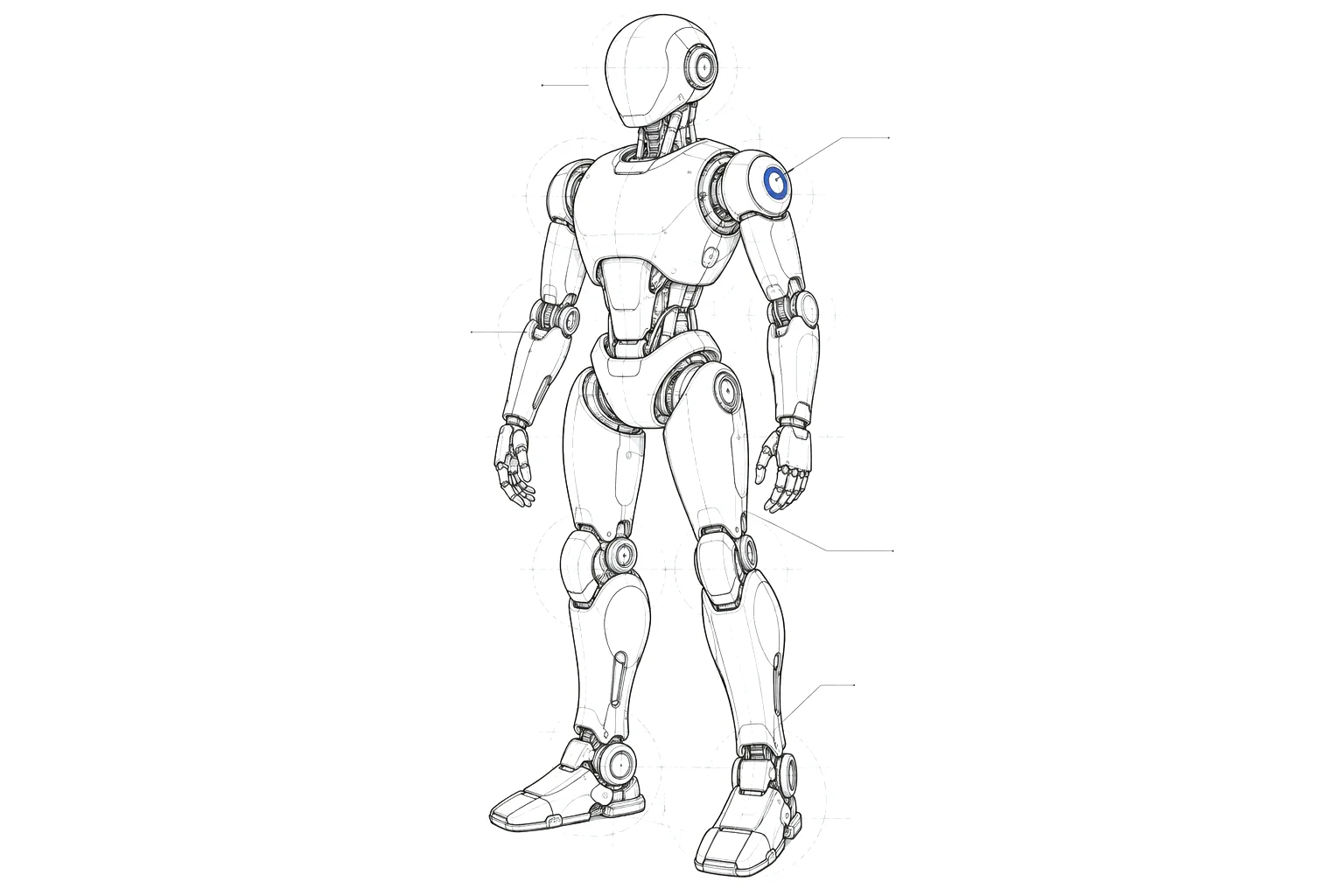
HALO trains a Unitree G1 in synthetic homes. It is still research.
Apple-affiliated researchers report a Unitree G1 system that transfers household-like movement from generated homes to six physical environments, but the result is a controlled research demonstration rather than a home robot product.
Without ever seeing a real home during training, HALO transfers zero-shot to the physical world, achieving a 91% success rate across 360 trials in six unmapped real-world environments.Hu et al., Perceptive Humanoid Motion from Simulation
HALO is a new research system for making a Unitree G1 move through home-like spaces using training data generated in simulation. The authors report a 91% success rate over 360 trials in six unmapped physical environments. That is a substantial real-robot result, but it does not mean a G1 is ready to work unsupervised in someone’s home. The paper is a preprint, and its demonstrations cover a defined set of movements rather than the open-ended chores consumers expect.
The result
The paper, submitted November 4, describes a system called HALO, short for Perceptive Humanoid Motion from Simulation. Its premise is practical: training a robot from camera images, spoken language, and joint movements normally requires expensive human demonstrations. The researchers instead built a synthetic-data pipeline around 1,000 procedurally generated homes.
They report that the resulting controller can combine motions such as sitting on a chair, going to a named object, squeezing sideways through a partly open door, crouching or crawling below furniture, pushing a box, and following a person. In the physical evaluations, the robot entered environments it had not mapped beforehand. The paper’s headline number is 91% success across 360 trials in six environments.
The project page makes the claim more concrete, showing a G1 carrying out tasks such as pushing a box away, following a person, and sitting after navigating through a room. The researchers have also released code and documentation for their data-generation, training, orchestration, tracking, and system components. That matters: it gives other researchers a path to inspect and reproduce parts of the work instead of treating a video as the entire record.
How it works
HALO splits the job into three layers. An orchestrator turns a request into smaller actions. A motion generator produces short whole-body plans from an egocentric RGB view and the current subtask. A tracker uses depth and the robot’s own joint-state information to follow that plan.
On the project page, the authors describe the orchestrator selecting the next subtask about every two seconds, the generator replanning five seconds of movement at roughly 3 Hz, and the tracker running at 50 Hz. The tracker controls 29 joint actuators on the G1. That division is important because a robot need not decide its entire route before it takes the first step; it can repeatedly reconsider a short segment as its view changes.
The training data is synthetic, not a stream of people teleoperating robots in real homes. The authors use generated scenes, generated motions, rendered egocentric camera views, and visual variation such as altered lighting and blur. This is a bet that enough variation in simulation will make the learned behavior tolerate the messier physical world.
What it means for a home robot
The encouraging part is not merely that the G1 walks. HALO joins movement and perception around ordinary spatial problems: furniture clearance, doors, chairs, boxes, and people. Those are the unglamorous things a domestic robot must handle before it can do useful work. Training in generated homes could also make it cheaper to create a wide range of layouts than collecting every example with a real robot.
But the system is not a consumer product, and the paper does not show a robot completing household chores independently over days or weeks. Its documented skills are mobility and simple object interaction, not cooking, cleaning, laundry, or safe handling of fragile and unpredictable household items. The reported six environments are also an evaluation set, not evidence of broad deployment in lived-in homes.
Caveats
The 91% figure is the authors’ reported aggregate across their selected trials, so it should not be read as a general home-safety or reliability rating. The result comes from a research team’s setup, hardware, task definitions, and success criteria. A home robot would face more varied lighting, clutter, pets, stairs, children, moving obstacles, and consequences for a mistake.
The work is also an arXiv preprint rather than a peer-reviewed product certification or a shipping announcement. The authors’ public repository is a positive sign for scrutiny, but released code is not the same as an independent replication. HALO is a useful step toward a robot that can move around a home with less hand-authored training data. It is not evidence that the household humanoid problem has been solved.
We labeled this story Research — A lab result, not a product. How we label claims
Sources
- Perceptive Humanoid Motion from Simulation4 Nov 2026
- HALO project page4 Nov 2026
- HALO code repository4 Nov 2026