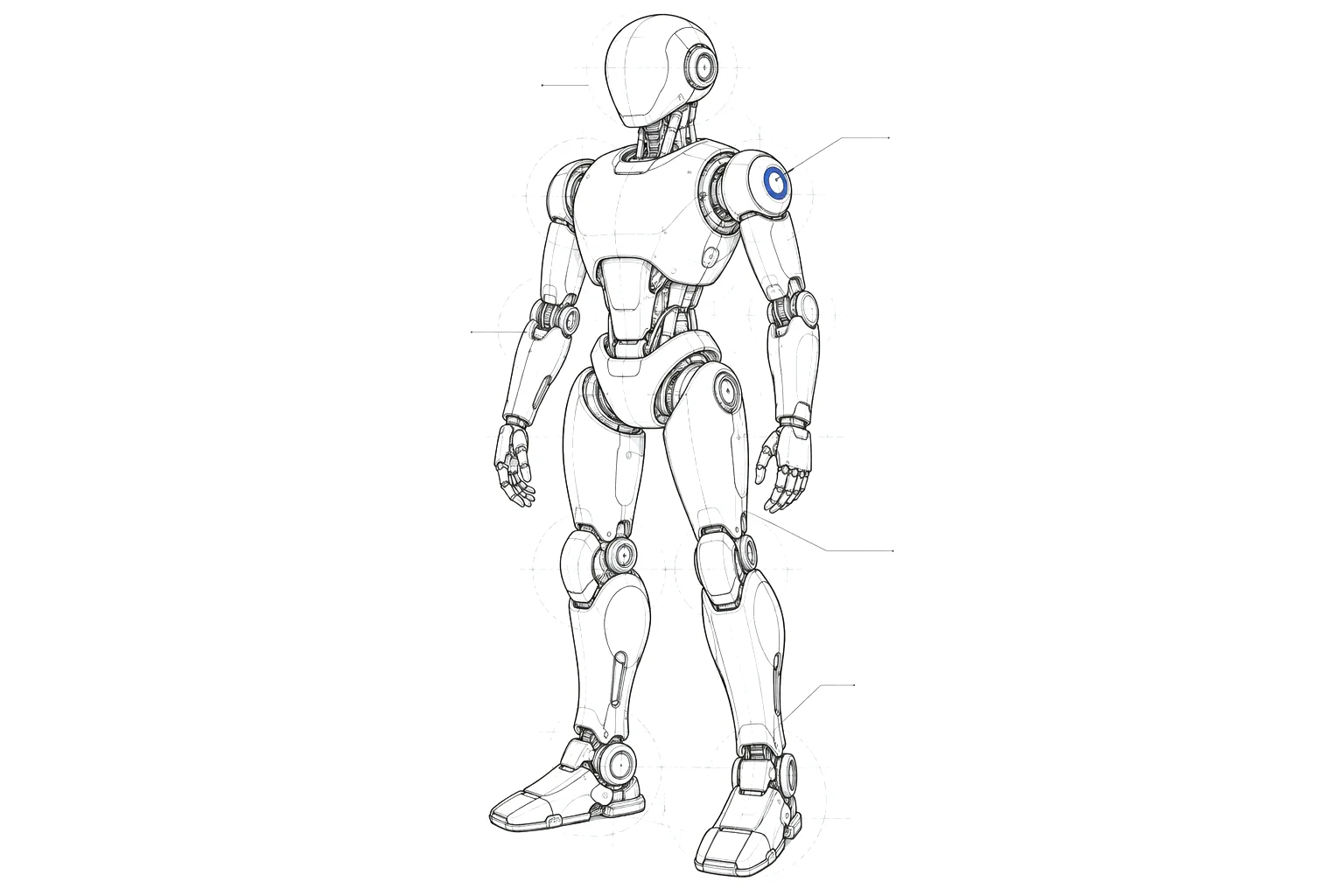
ViT-H turns a single camera into a Unitree G1 motion reference. It is still research.
A new paper generates robot motion directly from video and reports physical Unitree G1 demonstrations, but it does not show a home robot that can work without a carefully defined motion-tracking setup.
We further introduce an autoregressive variant that enables real-time humanoid video teleoperation with sub-400 ms latency.He et al., ViT-H arXiv abstract
A research team from Peking University and the Beijing Institute for General Artificial Intelligence has published ViT-H, a system that turns monocular video into reference motion for a humanoid robot. The authors tested it on a physical Unitree G1. That matters because many video-to-robot demonstrations still depend on a separate chain of human-motion reconstruction, retargeting, and robot tracking. ViT-H proposes to remove the first two steps from the deployed pipeline. It remains a research result, not a feature owners can buy for a home robot.
The result
ViT-H uses a diffusion model to generate a robot-oriented motion reference from a single-camera video, then passes that reference to a humanoid motion tracker. The paper says the approach was evaluated on Unitree G1 hardware as well as in its experimental benchmarks. Its online, autoregressive version is intended for video teleoperation rather than pre-recorded clips; the authors report sub-400-millisecond latency and list a 250-millisecond average on the project page.
The paper’s main claim is comparative: its generated references were more executable for the tracker than references from reconstruction-retargeting pipelines in the experiments the authors chose. That is useful progress on an old problem. A robot cannot benefit from a visually convincing human pose if its joints cannot follow the translated motion safely. The paper therefore uses tracking outcomes to post-train the motion generator, favoring candidate motions that the robot controller can execute.
How it works
The input is ordinary RGB video from one camera. Rather than first constructing a detailed human skeleton and then converting that skeleton into a robot pose, ViT-H predicts a G1 motion sequence directly. For real-time use, the system generates the next segment while incorporating the preceding motion segment. The authors call this a generation-and-tracking pipeline.
There is a practical reason for that design. Human bodies and humanoid robots do not have the same joint limits, proportions, balance constraints, or contact conditions. Each conversion step can introduce a motion that looks plausible in a video but is awkward or impossible for the robot. ViT-H’s post-training signal comes from motion-tracking results, which gives the generator feedback about that mismatch. The authors describe physical locomotion and loco-manipulation teleoperation demonstrations on their project site.
What it means for a home robot
For a future home robot, easier demonstration could be valuable. A person might show a motion with a camera rather than operate every robot joint through a specialized controller. But that is not the same as teaching a robot a household task. Moving like a person does not tell a machine which objects are safe to touch, how hard to grip a glass, where a cabinet door will stop, or when to ask for help.
The demonstrated target is also a Unitree G1 research humanoid, not a household product with verified in-home operation. The work concerns whole-body motion control and teleoperation. It does not establish autonomous cleaning, cooking, caregiving, or other long-horizon home tasks. A capable motion reference is one component of those jobs, alongside perception, planning, safety systems, hands, and robust recovery from errors.
Caveats
The experimental comparisons are the authors’ own, and the performance claims should be read within their datasets, trackers, and selected motions. The paper reports that motion-tracking feedback improves executability across several trackers, but that does not show that the method will generalize to every robot or an unstructured home.
The system also operates as teleoperation in its online mode. A human is still supplying the behavior through video; the robot is not independently understanding the task. The authors’ result is a better bridge from human movement to robot movement, not evidence that a humanoid can take over household work. That distinction is the useful one: ViT-H makes demonstrations less mechanically fussy. It does not make a home robot dependable yet.
We labeled this story Research — A lab result, not a product. How we label claims
Sources
- ViT-H: Generative Video-To-Humanoid Control with Motion Tracking Feedback23 Oct 2026
- ViT-H project page23 Oct 2026
- ViT-H full text23 Oct 2026