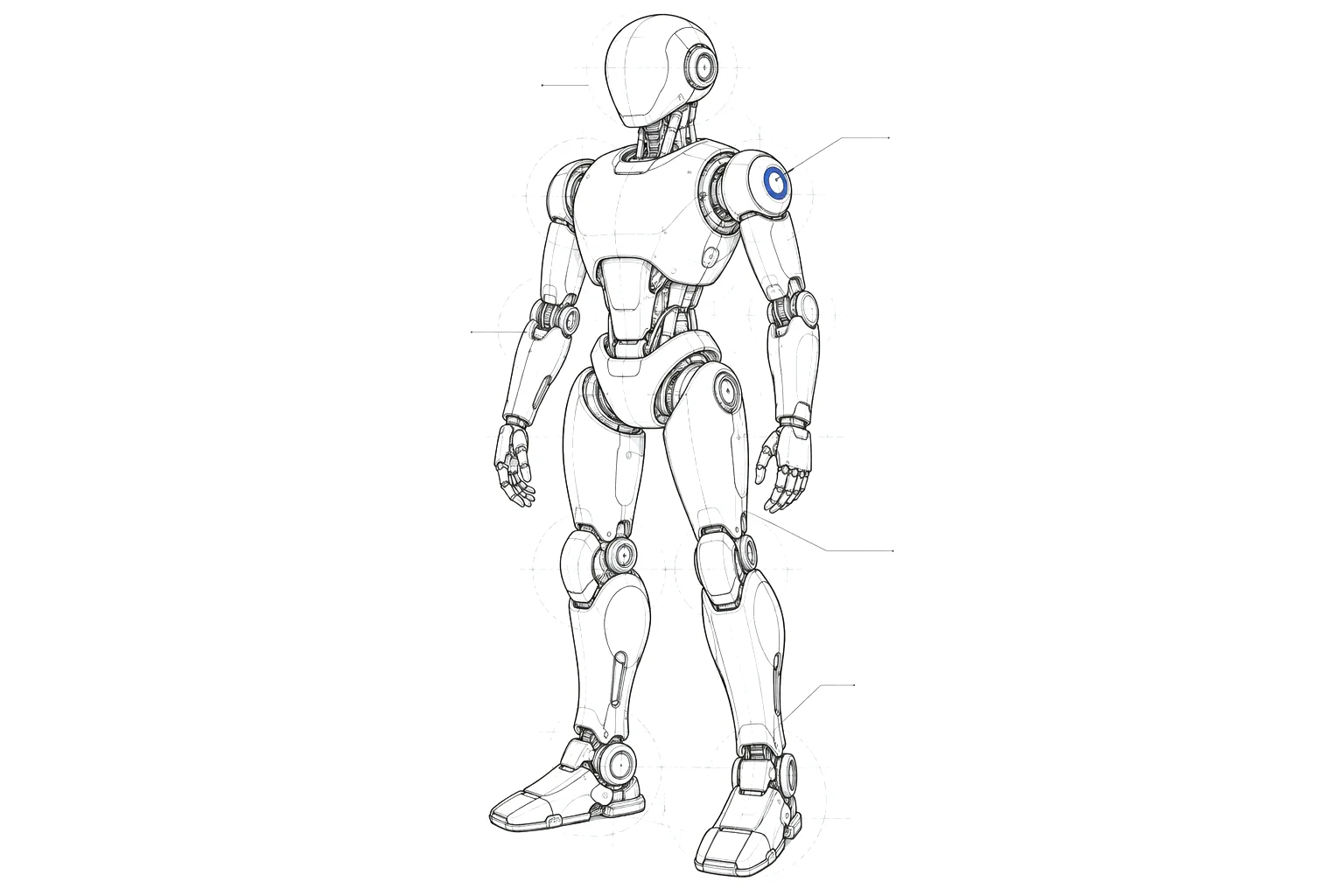
VioLA uses human motion data to control a Unitree G1. It is still research.
A new research system maps human and robot motion into the same control representation, then reports held-out laboratory results on one Unitree G1 without task-specific fine-tuning.
Evaluated on one Unitree G1, with five trials per task.VioLA project page
A humanoid can look capable in a short demo while still depending on a separate model and a carefully tuned controller for every new job. VioLA is a research attempt to reduce one bottleneck: the shortage of robot demonstrations for whole-body control. The authors report results on a single Unitree G1 in a laboratory. That is useful evidence about a control approach, not evidence that a robot can work safely and reliably in a home.
The result
The VioLA paper was posted on October 8. Its central claim is that a humanoid policy can learn from human recordings as well as robot data when both are translated into the same kind of motion target. Rather than asking a model to emit every joint command directly, VioLA predicts compact body and hand motion representations. Frozen controllers then turn those representations into commands for the robot.
The team tested the approach on one Unitree G1. Its project page says the evaluation used five trials per task. For locomotion and posture, it reports 30 successes in 30 trials across six tasks. For seven main whole-body manipulation tasks, it reports 31 successes in 35 trials, or 88.6%. Those tasks include closing a laptop, rotating a chair, and placing a toy.
The comparisons matter, but they are limited. In the reported no-task-specific-fine-tuning evaluation, the project page says released GR00T N1.7 completed 5 of 30 locomotion trials and Psi-0 completed none. The paper describes these as held-out evaluation episodes and laboratory conditions, not an independent field test.
How it works
Human motion is abundant, but a person moving through a room does not produce joint commands that a robot can use. VioLA addresses that mismatch with paired encoders: one processes human movement and one processes robot movement. Both map into shared latent spaces for the body and hands. A policy can then use images, a language instruction, and the robot's state to predict a motion target that pretrained robot controllers execute.
The authors say their converted training pool contains 140.6 million frames, 93.2% from annotated human recordings. The important distinction is not that the robot learned a household task from a video in the wild. It is that human recordings can supply a large share of the supervision for a policy whose output is compatible with the robot's controllers.
The paper also tests a human-only training variant for the generalist policy. That version completed 12 of 30 locomotion trials. The combined human-then-mixed approach completed 30 of 30, while a robot-only version completed 24 of 30 under the project page's matched training setup. These are reported results from the authors, not a consumer benchmark.
What it means for a home robot
Home robots need more than a grasping policy. They must walk, keep balance, reach around furniture, handle objects with uncertain shapes, and recover when something goes wrong. A method that lets a policy learn useful coordinated motion from human data could make it cheaper to build the behavior layer for those jobs.
VioLA's best result is therefore a training-data argument. Instead of collecting every example through teleoperation on a humanoid, researchers may be able to reuse labeled human movement for part of the learning problem. If that carries to broader tasks and environments, it could reduce a real practical constraint on general-purpose robots.
It does not settle the harder household questions. The results come from one G1, a small number of trials per task, and a laboratory setting. A 31-of-35 manipulation result also leaves four failures in the stated test set. Homes introduce varied layouts, pets, people, fragile objects, long task sequences, and safety expectations that a benchmark does not erase.
Caveats
This is a paper under review, not a product announcement. The authors say code and checkpoints are coming soon; they were not available through the primary project page when we checked. The project also defines zero-shot narrowly: no task-specific fine-tuning. It says task families appear in training, while the evaluation episodes, laboratory environment, and object instances are held out.
That clarification is worth keeping. A robot that performs a familiar class of task with new instances has shown something real, but it has not demonstrated open-ended competence in an unfamiliar home. The reported results make VioLA a research result to watch, particularly for how it joins human and robot data. They do not change the status of the Unitree G1 from a shipped platform into a verified home helper.
For now, VioLA shows one way to make human motion useful to a humanoid controller. It still needs broader robots, environments, independently reproduced trials, and evidence that its failure cases are manageable around people before it says much about a machine living in someone's home.
We labeled this story Research — A lab result, not a product. How we label claims
Sources
- VioLA: Learning Generalist Humanoid Control Policies from Human Data8 Oct 2026
- VioLA project page8 Oct 2026
- VioLA paper HTML8 Oct 2026