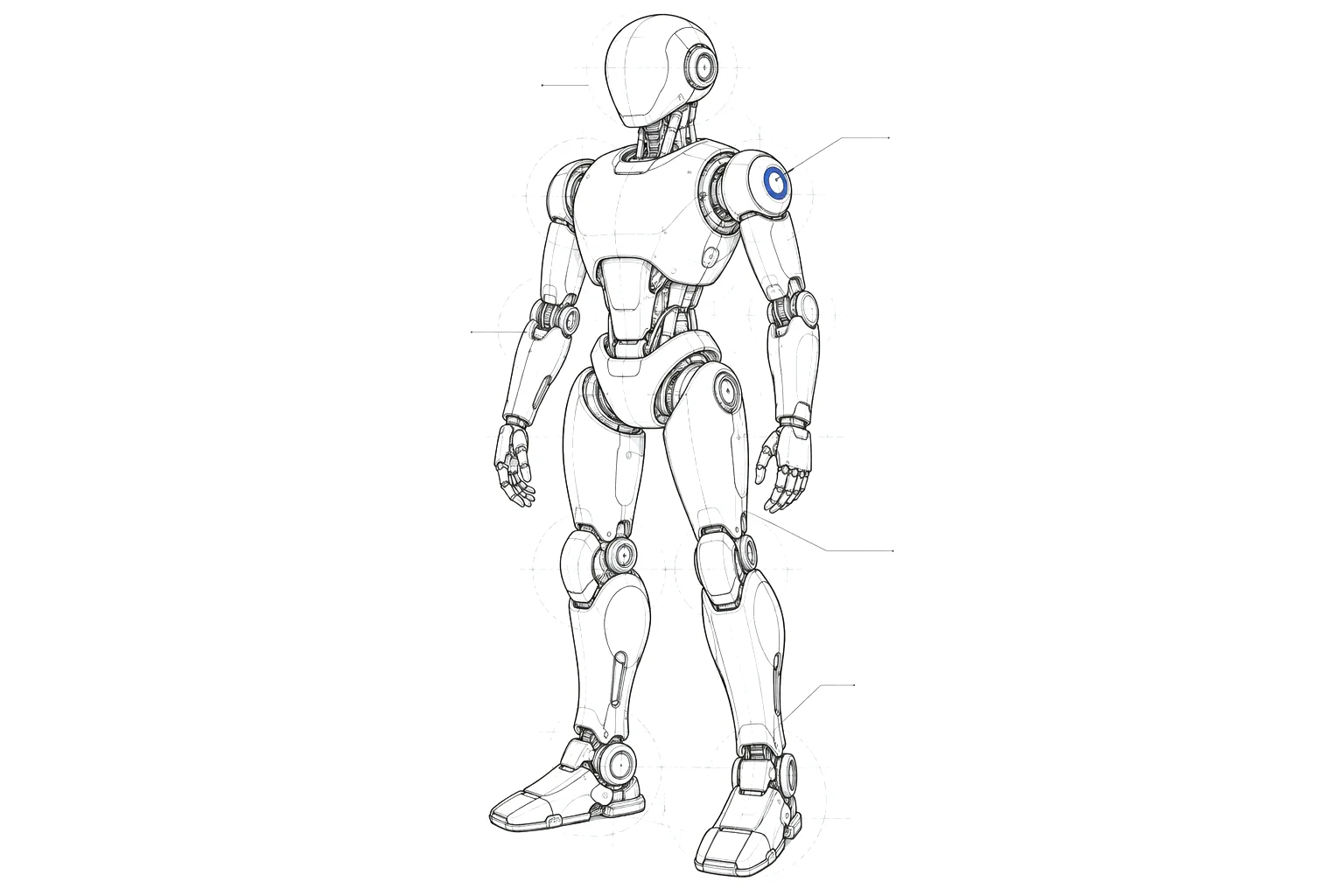
A diffusion model writes Unitree G1 control policies. It is still research.
UC Berkeley researchers generated humanoid controller weights with diffusion and ran them zero-shot on a Unitree G1, but the demonstrations are narrow lab motions rather than household work.
Policy networks generated by a diffusion model, running on real hardware.Cheng et al., project page
A robot policy is usually the thing trained to make the next move. A new UC Berkeley paper takes a stranger route: it trains a diffusion model to generate the policy's weights, then uses those sampled weights to run a Unitree G1. The authors show walking, dancing and a spin kick on physical hardware without fine-tuning. That is a useful result about how humanoid controllers might be produced and studied. It is not a home-robot breakthrough.
The result
The paper, Modeling and Understanding Neural Weights of Humanoid Policies with Diffusion, was submitted to arXiv on October 14. Its central claim is specific: a model can generate usable neural-network parameters for a motion controller rather than directly generate actions or a planned trajectory.
The team trained separate diffusion models around three Unitree G1 motions: velocity-command walking, rhythmic whole-body dancing and a spin kick. According to the authors' project page, every displayed hardware clip uses a network sampled from the diffusion model and deployed on the physical G1 without fine-tuning. The project page's 28-second demo is evidence of those demonstrations, not evidence that the robot can generalize to chores.
Their training set came from 750 reinforcement-learning runs with different random seeds. The researchers kept eight post-convergence networks from each run, for 6,000 networks per motion. Each policy is a three-layer multilayer perceptron that maps the robot's observations to 29 joint targets.
How it works
A trained controller has tens of thousands of parameters. Instead of asking a diffusion model to work directly over all of them, the researchers flatten a controller's weights and biases, then compress that representation with a linear autoencoder. They report a 2,048-dimensional latent representation before training a diffusion transformer to sample new latents. Decoding a sample yields a new controller.
That framing matters. Conventional diffusion policies often generate an action sequence or trajectory while the robot is operating. Here, the diffusion model is used before deployment to produce a fixed policy network. Once decoded, the resulting controller runs on the G1 at its normal control rate; the diffusion model is no longer in the loop.
The authors also examine the weights themselves. They report a recurring structure in the first layer that they interpret as a representation of the robot's kinematic prior, appearing in policies trained with both reinforcement learning and imitation learning. It is an interpretability observation about their controllers, not a new sensor or capability for the G1.
What it means for a home robot
The near-term value is research leverage. If controllers for related motions can be sampled rather than trained one by one, a lab may have more ways to explore candidate policies and compare what they have learned. The physical G1 demonstrations make this more substantial than a simulation-only result.
But the demonstrated motions do not test the hard parts of a home robot: recognizing unfamiliar objects, handling a changing room, recovering from errors, working around people, or finishing a long task safely. Walking, dancing and a spin kick are useful whole-body-control tests, yet none establishes reliable kitchen, laundry or cleaning work.
The paper also trains on networks produced for defined motions. It does not show one general controller that takes a household instruction and safely performs a varied sequence of actions. Consumers should read the work as a result about the production of low-level humanoid policies, not as a new autonomous feature arriving on a Unitree G1.
Caveats
This is a preprint under review, not a peer-reviewed product evaluation. The authors provide a demonstration and describe real-hardware deployment, but the project page does not turn the reported motions into a broad reliability claim. Its table evaluates 100 generated networks, and it says fewer than 10% of samples exhibit performance collapse for its best-90% comparison; that is a measurement inside the authors' experimental setup, not a home-use reliability figure.
The work uses a Unitree G1 as a research platform. It does not announce a Unitree software release, a consumer feature, or an update to the robot's delivery status. It is a promising method to study, with a clear boundary: the lab has demonstrated generated controllers for three motions, not a humanoid that can do housework.
We labeled this story Research — A lab result, not a product. How we label claims