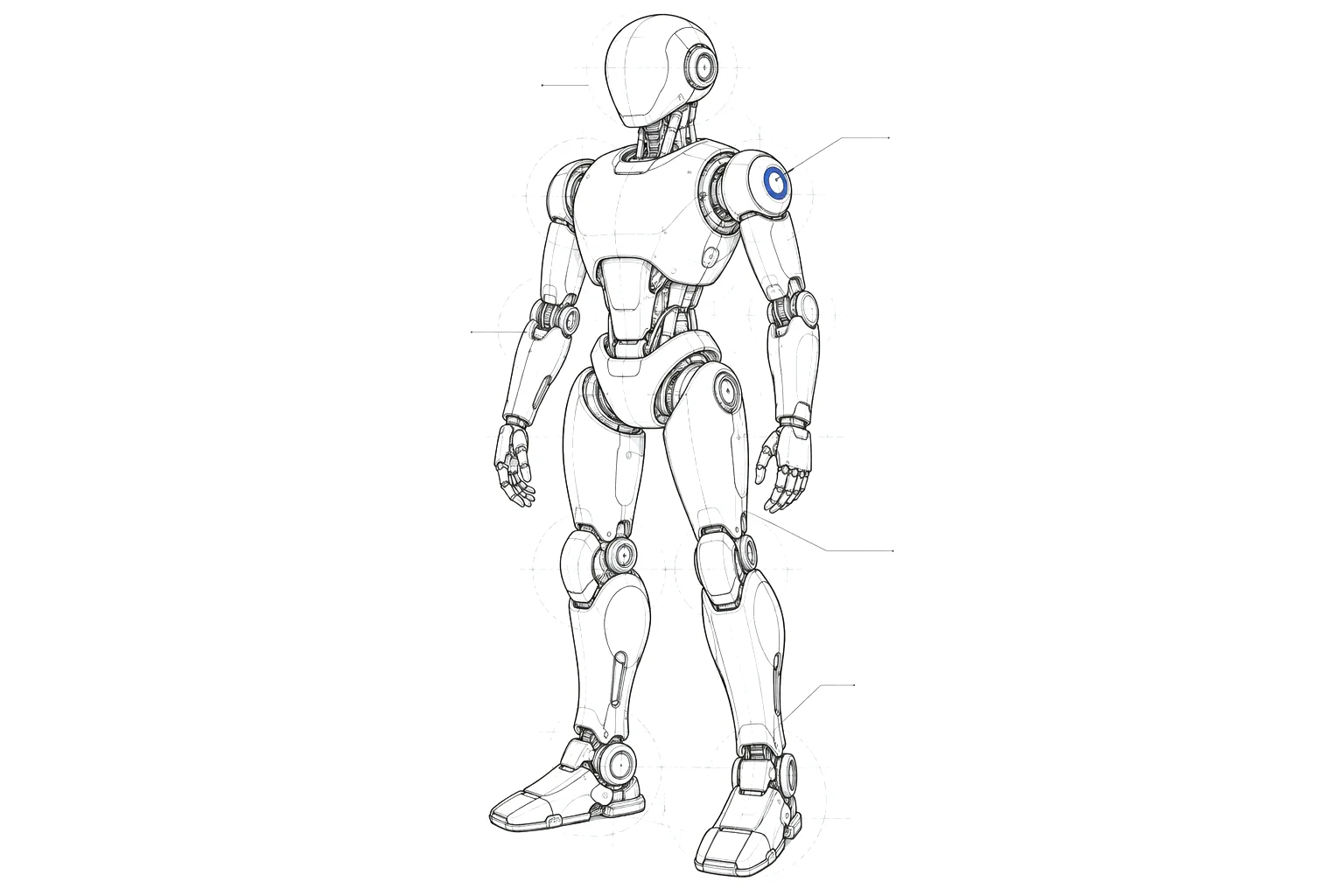
Unitree says humanoids could handle 80% of spoken tasks by 2028. That is a target, not a home-robot result.
Unitree founder Wang Xingxing has set a 2028 goal for humanoids to complete most assigned voice tasks in homes or factories, while acknowledging that a robot cannot reliably clean a room today.
What they said
Unitree founder Wang Xingxing says he expects humanoid robots to complete 80% of assigned tasks in factories or homes after spoken instructions as soon as 2028. Bloomberg reported the target on October 23, describing it as Wang’s threshold for an ‘aha’ moment in practical robotics.
That is a promise about a capability threshold, not a launch date, an order page, or proof that a household robot can do most domestic work. The statement applies to tasks assigned by voice across two very different settings: homes and factories. Unitree did not publish a task list, a test protocol, a success threshold for individual chores, or evidence that an outside evaluator has measured the result.
The reported route to that goal is a project Wang calls Unitree Rehearsal. The Next Web’s account says the proposed system would search research papers, write code, test it in simulation, then use real-robot feedback to adjust models. That is a familiar research and engineering loop at a larger scale, not evidence that the loop already produces a broadly capable household assistant.
What is verified
Two things are clear from the reporting. First, Wang made the 2028 prediction. Bloomberg says he expects humanoids to handle 80% of assigned factory or home tasks after verbal orders. Second, Wang’s present-tense assessment is much narrower: a humanoid taken home today cannot reliably clean a room. The latter matters because room cleaning is not a single skill. It includes moving through an unfamiliar space, recognizing what belongs where, handling objects safely, adapting to messes, recovering from errors, and knowing when to stop.
Unitree already sells humanoid hardware. ShinyMetal lists the G1 and H2 as shipping products. Shipping hardware does not establish that either model can independently complete household work after a voice request. The current status records availability, not the broad autonomy implied by the 2028 prediction.
The distinction is especially important for the word ‘task.’ A robot can perform a constrained action in a prepared setting while still failing the ordinary version of the job. ‘Put the cup in the dishwasher’ becomes harder when the cup is behind another object, the dishwasher is closed, the rack is full, the floor is wet, or a person changes the instruction halfway through. No public evaluation details in the reports show how Unitree plans to count those cases.
What is missing
The target leaves several practical questions unanswered. Unitree has not publicly defined the 80% denominator: which tasks count, who assigns them, how much setup is allowed, and whether a human can intervene. It has not said whether success means one attempt, repeated use across homes, or performance after a household changes around the robot.
There is also no published schedule for a consumer product that reaches the claimed threshold, no price, and no indication that a buyer could test the claim before purchasing. Wang’s remarks cover factories as well as homes, but those environments can be more structured, with standardized objects, mapped routes, safety processes, and staff nearby. Results in one should not be treated as proof for the other.
The reports describe individual demonstrations such as painting and playing Go, but demonstrations are not a benchmark for household reliability. A useful home robot must make safe decisions around people, pets, stairs, clutter, fragile objects, and changing instructions. It must also fail in a way that does not create a bigger job for the owner. Unitree has not supplied public evidence for that full package.
The company’s own caution is the most useful baseline here. As Wang put it: “If you take a humanoid home now and ask it to clean the room, honestly I don’t think it can complete that task.” That is more informative for a buyer than a date attached to a broad capability claim.
What it means for a home robot
Treat 2028 as Unitree’s forecast, not a delivery promise. It signals that the company believes better models, more simulation, and faster feedback can improve its robots quickly. It does not tell a household when a robot will reliably clean, organize, cook, or provide unsupervised help.
For now, prospective owners should ask narrower questions: Which chores has the exact model completed in ordinary homes? How many homes and repetitions were involved? Was the robot teleoperated, supervised, or reset between attempts? What happened when it made a mistake? Those details turn a video or an executive prediction into something a household can evaluate.
A 2028 target may prove useful as a checkpoint. Until Unitree publishes independent, repeatable evidence against a defined set of home tasks, the honest label remains promise. The company is describing where it intends capability to go, while also saying today’s humanoid cannot yet handle a basic room-cleaning request on its own.
We labeled this story Promise — The company said it will happen. How we label claims