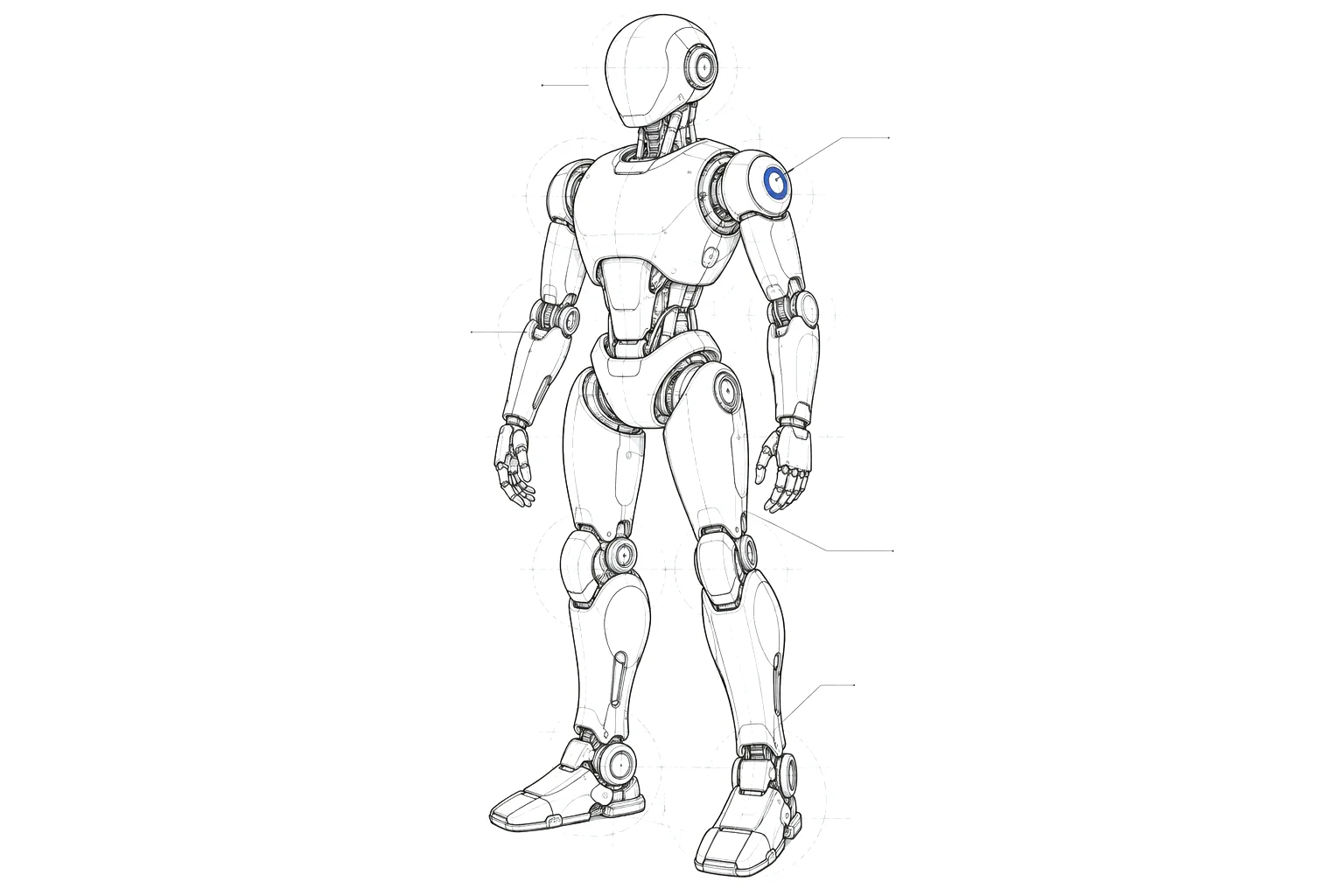
SuperMimic trains a Unitree G1 motion controller with a learned world model. It is still research.
A new UC Berkeley paper reports lower simulated training cost and physical Unitree G1 motion transfer, not a household robot that can do useful work on its own.
Our policy transfers to a physical Unitree G1 across diverse and acrobatic motions.Qiayuan Liao et al., SuperMimic
The result
A UC Berkeley team has posted SuperMimic, a whole-body motion-control system for humanoids. The result is a training method, not a robot product: the authors say they transferred its policy to a physical Unitree G1 for diverse and acrobatic motions.
The paper’s central claim is about compute. It reports that, after three hours on one GPU, its controller surpassed the reported return of a comparison motion-tracking baseline trained for seven days on 128 GPUs. In the authors’ 129,514-motion benchmark, it reports 25 failed motions after that three-hour run, compared with 179 for the cited baseline. After 9.8 hours on two GPUs, the paper reports zero failures on that benchmark. Those are the authors’ experimental results, not an independent product test.
The project page identifies the work as UC Berkeley research accepted as a CoRL 2026 oral, but currently offers no additional demonstration material beyond a link to the paper. The project page says it is coming soon.
How it works
Many humanoid trackers learn by repeatedly sampling a simulator, a process that can demand large pools of graphics processors. SuperMimic instead learns a differentiable approximation of the simulator’s dynamics from logged simulation transitions. The controller then improves itself through short imagined rollouts inside that learned model.
That arrangement matters because the controller can obtain gradients from its imagined outcomes rather than waiting for a model-free reinforcement-learning loop to discover them through more simulation. The paper says the world model and policy are trained together and that the deployed policy uses noisy proprioceptive observations plus a goal input.
The physical transfer is meaningful but narrow. The abstract says the policy transferred to a real G1 across motion-tracking tasks; it does not say the robot completed household chores, handled varied objects, or ran unattended in a home.
What it means for a home robot
Cheaper motion-policy training could make it easier for researchers and robot makers to test more movements, recoveries, and whole-body behaviors. That is useful groundwork for a home robot: a machine that cannot move reliably around furniture, reach, crouch, or recover balance will not be helpful with chores.
But motion tracking is only one layer of the household problem. A useful home robot also needs reliable perception, task planning, manipulation, safety around people, and a way to cope with messy environments rather than a defined motion target. SuperMimic does not claim to supply those pieces.
For G1 owners and developers, this is evidence that sim-to-real whole-body control research is advancing. It is not evidence that a stock G1 has acquired a general-purpose domestic skill.
Caveats
The benchmark, baseline comparison, compute estimates, and real-robot transfer are all reported by the paper’s authors. We found no independent replication or third-party evaluation in the sources opened for this article.
A learned world model can also inherit gaps from its simulator and training data. The paper says it remained stable as its motion dataset grew from one to 264 hours, but that does not establish robustness to contacts, clutter, people, or the changing conditions of a home.
This is research released on October 20, not a shipping capability. The right next evidence would be repeatable, independently observed real-robot tests that include manipulation and recovery in an uncontrolled setting.
We labeled this story Research — A lab result, not a product. How we label claims