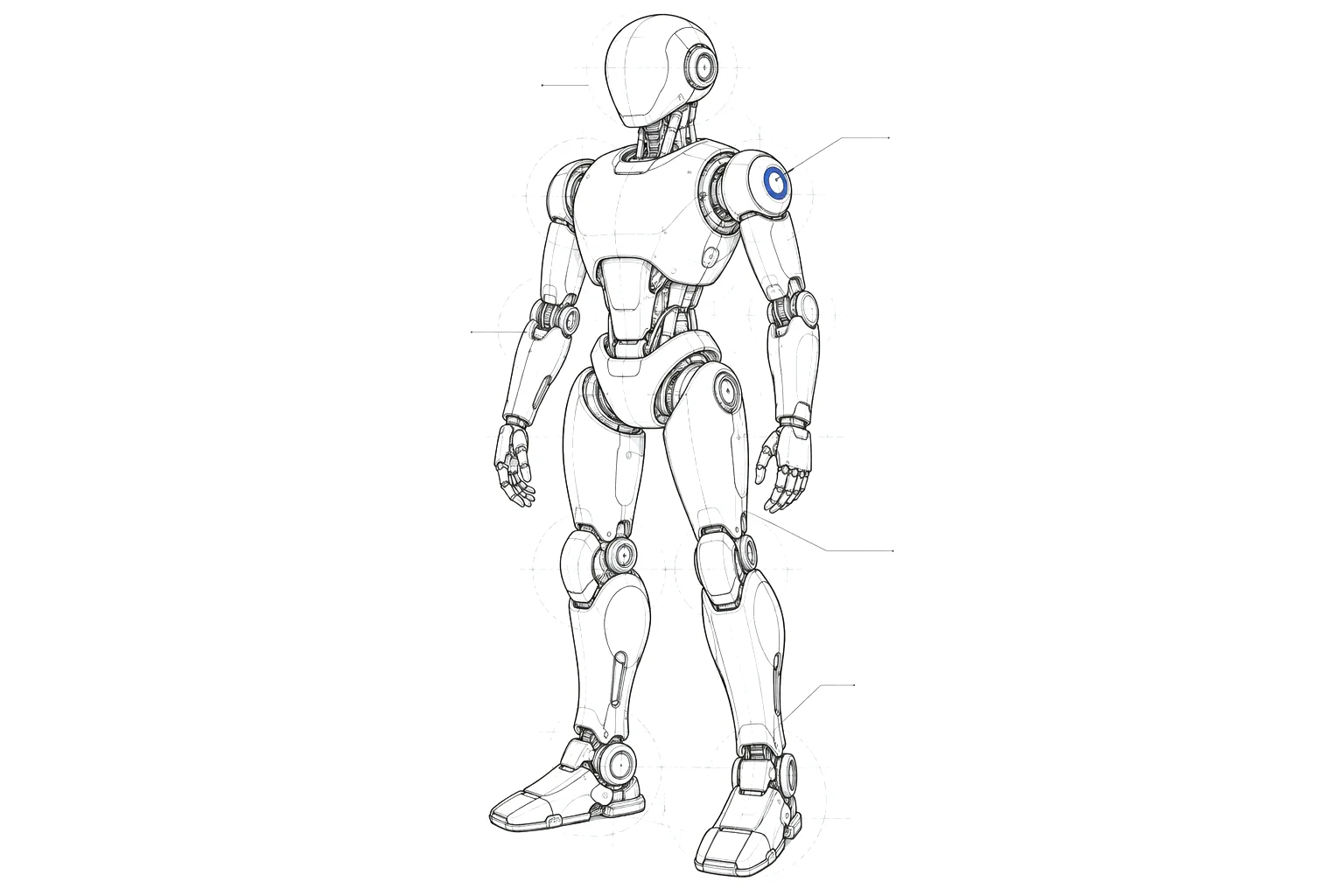
ROOF teaches a Unitree G1 to get up when the ceiling is in the way. It is still research.
A new paper reports recovery tests beneath tables and other obstacles, but the controller has not been tested as a home robot safety system.
On a Unitree G1, the deployed policy recovered in 95 of 150 attempts across seven real-world obstacle scenes, including furniture and multi-object arrangements absent from training.Lu et al., ROOF paper abstract
A humanoid that falls beside a table has a problem a clean-floor demo can ignore: standing up may drive its torso into the furniture above it. A paper called ROOF, posted October 30, reports a controller meant to handle that awkward middle step. On a Unitree G1, the authors say it recovered in 95 of 150 physical attempts across seven obstacle scenes. That is a useful result for robot recovery research. It is not evidence that a humanoid is ready to fall, assess a living room and safely resume work around people.
The result
ROOF stands for learning humanoid fall recovery under overhead constraints. The research team tested a policy on a Unitree G1 beneath tables, around furniture and among multiple objects. In one type of setup, the robot had to move itself beyond a fixed table edge before it could rise. In another, it could push a movable obstruction aside.
The reported hardware result is 95 recoveries in 150 attempts, or about 63 percent, across seven real-world obstacle scenes. The linked project page shows examples beneath 70-centimeter and 40-centimeter tables, plus arrangements involving a box, timber, a ladder and a board. That is more revealing than a recovery on an empty lab floor because the robot must make room before it stands.
The authors also report stronger simulation scores: 88.5 percent beneath plates that could only be lifted and 98.6 percent beneath movable plates with randomized size, mass and placement. Those simulation figures should not be read as home performance. The physical G1 result is the relevant number here, and it leaves many failed attempts.
How it works
The controller is trained to reduce the overlap between the robot and an obstacle while maintaining enough support to rise. Rather than prescribing one escape route, the training reward favors creating clearance. A learned motion prior is meant to keep the movements coordinated; additional costs shape support, posture and joint behavior.
There is an important boundary in the setup. The paper says obstacle geometry is available during training to calculate the guidance signal, but the deployed policy uses proprioception alone. In plain terms, the robot is not described as using a general household perception system to recognize every nearby chair, person or fragile object while it recovers. It is executing a policy learned from the kinds of constrained scenes the researchers constructed.
That distinction matters because getting up around furniture combines contact, balance and judgment. A useful household robot would need to know whether an object can be moved, whether a hand is in the way, whether the surface beneath it is slippery and whether a person is close enough to be hit by a leg or arm. ROOF addresses a narrower but real part of that problem: how to make enough physical room to rise.
What it means for a home robot
Fall recovery is not a glamorous capability, but it is foundational. A home robot that cannot recover from a low, constrained fall either needs human help or becomes an obstacle itself. The tests here show that a G1 can sometimes reorganize its body and nearby objects before standing, instead of treating every recovery as a fixed choreography.
For a home setting, the promising part is the variety of obstacle arrangements. The project page includes fixed furniture, loose pieces and different starting orientations. That is closer to the clutter problem than a single rehearsed get-up. Still, the paper does not report long-duration operation in occupied homes, autonomous fall detection, hazard classification, or a method for deciding when recovery is too risky to attempt.
The work is also not a product announcement from Unitree. It is an academic result run on a Unitree G1, and the paper does not say that the controller ships with the robot. Buyers and observers should treat it as a demonstration of a research direction, not a new G1 feature.
Caveats
The physical success rate is not high enough to call recovery dependable: 55 of the reported 150 hardware attempts did not recover. The paper’s obstacle scenes are varied, but they remain selected test configurations rather than ordinary, unsupervised homes. The tests also do not establish safety around people, pets, glassware, stairs or soft furnishings.
ROOF gives researchers a useful question to test: can a fallen humanoid alter the configuration that blocks it before it tries to stand? Its answer is sometimes yes on a G1. Turning that into a safe, reliable domestic behavior will require much more than a better get-up policy.
We labeled this story Research — A lab result, not a product. How we label claims
Sources
- ROOF: Learning Humanoid Fall Recovery under Overhead Constraints30 Oct 2026
- ROOF project page30 Oct 2026