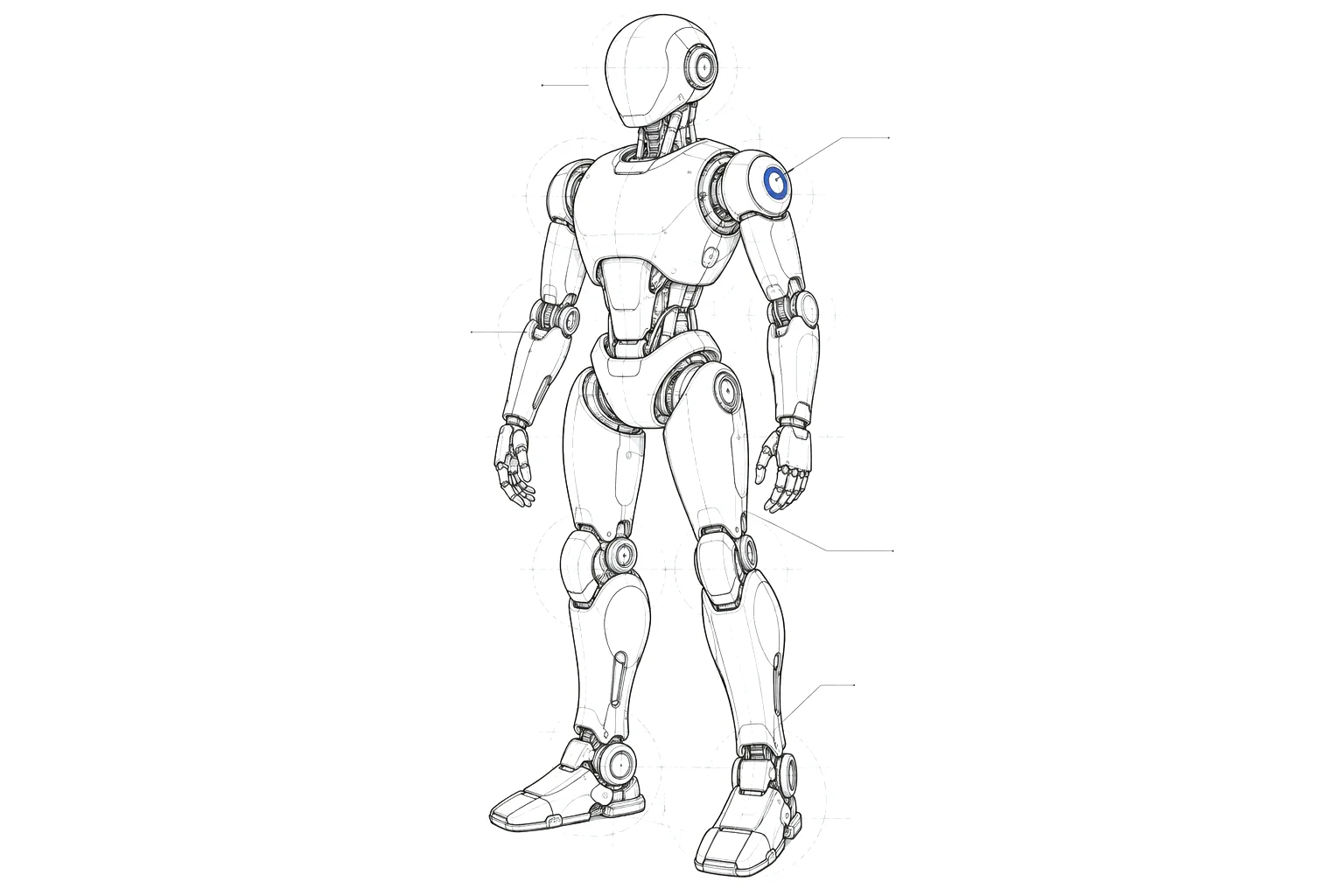
Humanoid Dodgeball gives an EngineAI PM01 a fast reflex. It is still research.
A new paper reports projectile-avoidance tests on a PM01 humanoid, but the system relies on motion-capture obstacle positions and does not establish safe autonomy in a home.
A humanoid that can move out of the way of a thrown object has a useful reflex, but it does not yet have the perception, judgment or safety case for a family room. A paper posted October 29 reports that an EngineAI PM01 learned whole-body avoidance moves against incoming projectiles. The authors call the work Humanoid Dodgeball. It is a research result, not a product feature or a demonstration of independent home operation.
The result
The paper describes a reinforcement-learning system for making a humanoid evade moving obstacles while keeping its balance. Its policy combines rewards for recognizing a threat with motion priors intended to keep the response stable and human-like. The reported tests cover simulations and hardware experiments, including an EngineAI PM01.
The accompanying project page shows two kinds of hardware moves: the PM01 steps forward to avoid an incoming object and jumps backward in another trial. That is a meaningful distinction from a static obstacle course. The robot has to react before contact, move its whole body, and recover its balance afterward.
The paper says its method improves avoidance performance across different projectile speeds and launch distances. That comparison belongs to the authors' evaluation, not to a general claim that the PM01 can handle household hazards. We could not find a customer-facing EngineAI announcement that makes this controller part of a shipping robot.
How it works
During training, the method estimates how an incoming projectile threatens key parts of the robot's body. It uses those estimates to shape rewards for evasive movement. The system also uses direction-specific adversarial motion priors: a policy meant to escape in one direction is encouraged to produce a different kind of motion than one escaping another way. Recovery rewards then favor returning to a stable posture once the immediate threat passes.
The hardware setup matters as much as the learned policy. The project page says the deployed actor receives obstacle positions estimated from a motion-capture system. That is much more controlled than a robot in a home interpreting a fast object through its own cameras amid pets, people, furniture and poor lighting. Motion capture can supply a clean position estimate; a consumer robot would need to earn that estimate from onboard sensing, then decide whether moving is safer than stopping.
The platform itself is not hypothetical. ShinyMetal lists the EngineAI PM01 as Shipping, based on its commercial availability. But a shipping chassis and a research controller are separate facts. This paper demonstrates the latter in a research setup.
What it means for a home robot
Fast protective movement could matter in a home. A robot carrying an object may need to avoid a child, a closing door, or something dropped from a counter. A useful response must do more than avoid the object. It must account for nearby people, its own payload, floor traction, furniture, and whether a sudden step creates a new danger.
This work addresses one narrow piece: producing a quick whole-body movement in response to a known incoming obstacle. That is a foundation for safer motion, not proof of a useful domestic robot. The paper's use of an actual humanoid is more informative than a simulation-only result, but it does not show chores, navigation through an occupied home, or an onboard visual system coping with ordinary clutter.
Caveats
The result is a preprint, not a peer-reviewed product specification. The authors report hardware experiments, but the paper does not present a consumer deployment, a home trial, or a claim that the PM01 can autonomously protect people in unscripted settings.
Most importantly, the hardware deployment uses motion-capture-based obstacle positions. That removes a major real-world problem: seeing and tracking an approaching object reliably with the robot's own sensors. The paper also studies fast projectiles, which is a useful stress test but not a complete model of household interaction.
For now, Humanoid Dodgeball is evidence that a humanoid can be taught a sharper evasive reflex under controlled conditions. It is not evidence that the robot knows when, where or whether to make that move in your home.
We labeled this story Research — A lab result, not a product. How we label claims