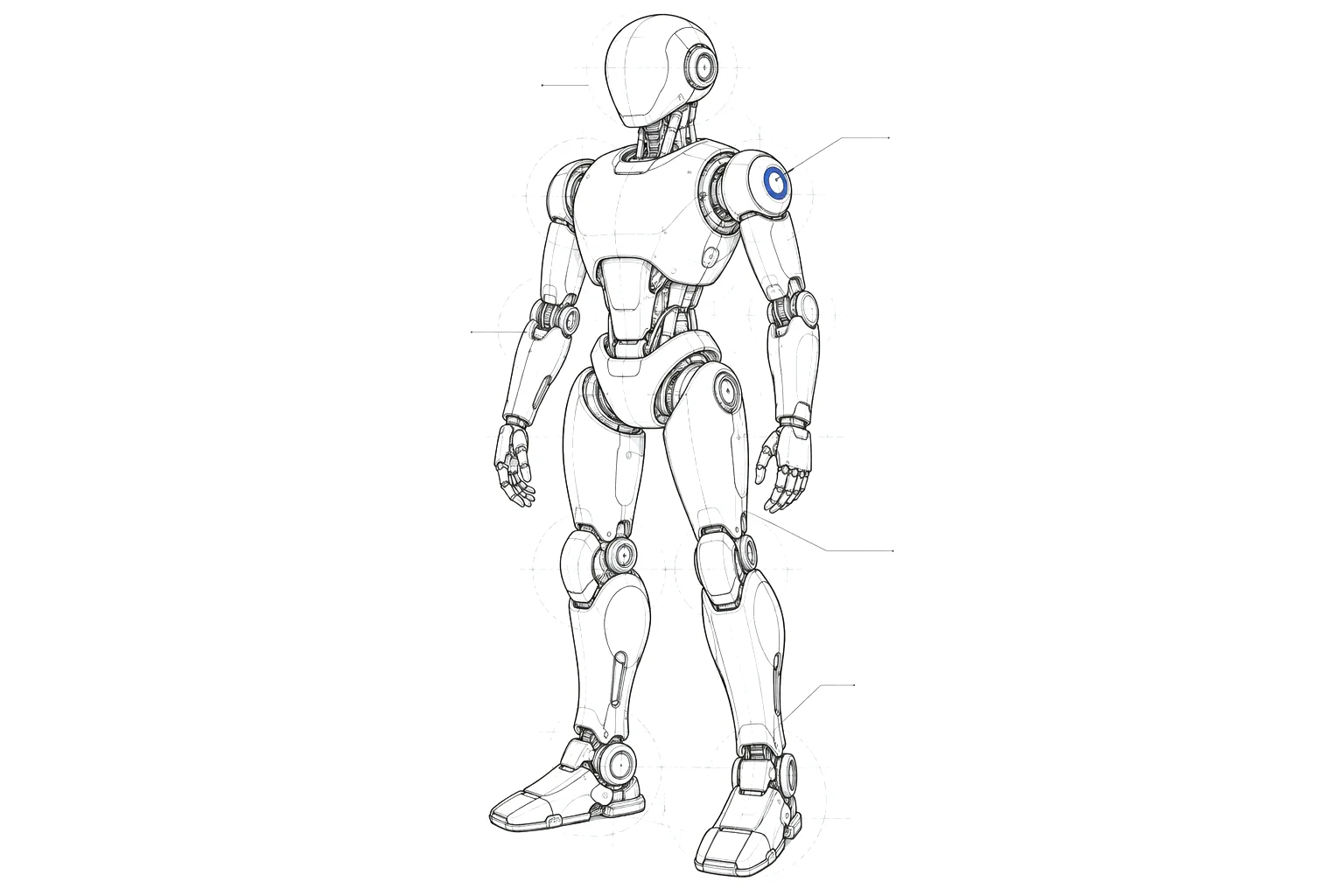
Being-M0.7 plans ahead for a Unitree G1. It is still research.
A new humanoid-control paper combines more than 10,000 hours of human data with robot-specific training, then reports controlled Unitree G1 results rather than a home-ready product.
Being-M0.7 achieves the highest aggregate success rate among the compared baselines on SIMPLE and matches the strongest baseline on real-world Unitree G1 loco-manipulation tasks.Being-M0.7 paper, arXiv
The result
Being-M0.7 is a research system for humanoid loco-manipulation: the awkward combined problem of walking, balancing and using the arms at the same time. The authors say their model learns a broad prior from more than 10,000 hours of human-centered video and motion data, then receives robot-specific post-training before it controls a Unitree G1. The paper was submitted to arXiv on October 8.
The reported result is narrower than a home-robot debut. On the authors’ benchmarks, Being-M0.7 leads their compared methods on an aggregate SIMPLE score and matches the strongest baseline on real-world G1 loco-manipulation tasks. Those are useful controlled results, but they do not establish that a G1 can reliably complete open-ended household work.
The key idea is to give the controller a rough prediction of what should happen next, rather than asking a policy to react only to the current camera frame. The authors call that combination a latent world-action model.
How it works
The system has two layers. First, a video-motion prior learns from three kinds of human data: paired egocentric video and motion, video without motion, and motion without video. The authors say this lets them use a larger pool of human activity without requiring every training example to be an expensive robot demonstration.
That prior does not emit motor commands directly. It predicts future visual and whole-body motion representations. A second, future-conditioned action expert combines that predictive context with current robot images and proprioception to produce short sequences of executable actions. The official project page says the visual side uses frozen DINO features rather than raw pixel prediction, and that the predictive prior updates at a lower frequency than the action controller.
For robot post-training, the team collected data on a Unitree G1 through VR-based whole-body teleoperation. The project page describes an operator using a headset, handheld controllers and ankle trackers; a motion-tracking controller turns the operator’s motion into robot commands while recording the robot’s camera views, state and actions.
That distinction matters. Human data may help a model learn useful regularities about bodies, objects and sequences, but it does not become safe robot behavior by itself. The robot-specific training is the bridge, and its quality and scope set the limits of the demonstration.
What it means for a home robot
A household robot needs more than a good grasp or a stable walk. It needs to move through an unfamiliar room, keep track of fragile objects, recover from small errors and know when not to continue. A model that plans with a prediction of future motion could be a useful ingredient for that job because many home tasks require the base and arms to coordinate over several seconds.
The work also points toward a practical data strategy. Robot demonstrations are slow and costly. If human video and motion can supply some of the general prior, robot time can focus on embodiment-specific control, contact and safety. That could make it easier for research teams to test new behaviors on available platforms such as the G1.
But the G1 in this paper is a research platform, not a household helper. ShinyMetal lists it as shipping to research and business buyers, while noting that useful task behavior depends on buyer code or teleoperation rather than a consumer chore service. Its current record also documents hardware and security limitations that a polished home product would have to address.
Caveats
This is a paper and a project demonstration, not evidence of a product that customers can buy for chores. The reported comparisons are the authors’ comparisons, and the arXiv paper has not yet gone through peer review. The paper’s claim of matching the strongest baseline on real-world G1 tasks does not mean it beats every existing humanoid controller, nor does it translate into a household reliability rate.
The training data figure also deserves careful reading. The more-than-10,000-hour total is a raw collection of mixed human-centered data before filtering and temporal segmentation, according to the project page. It is not 10,000 hours of a robot doing chores, and the paper does not claim it is.
The useful takeaway is modest: predicting a rough future for both a scene and a body may improve a humanoid controller’s options in controlled tasks. What remains unshown is the harder part: dependable, safe operation across the clutter, exceptions and long tail of a real home.
We labeled this story Research — A lab result, not a product. How we label claims
Sources
- Being-M0.7: A Latent World-Action Model for Humanoid Robots8 Oct 2026
- Being-M0.7 project page14 Jul 2026