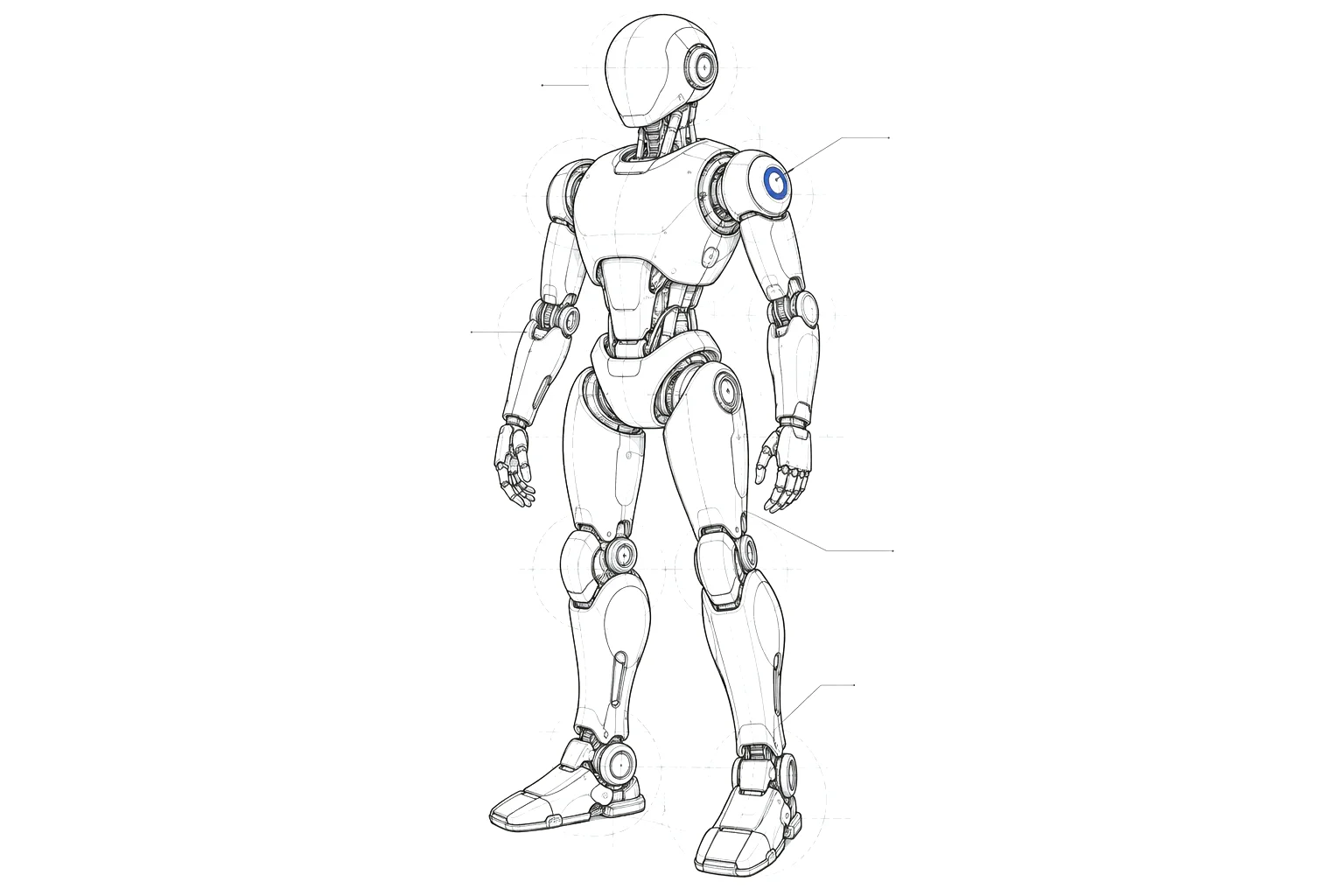
Agility's Digit 5 is built to work next to people. Here is what that claim rests on
A 50 lb lift, a 9-minute charge and a new safety system, backed by $300 million in orders with conditions attached.
Digit 5 is removing a major barrier to scaling humanoid robots in industrial environments.Peggy Johnson, CEO, Agility Robotics press release, 2026-09-15
What they said
On 15 September 2026 Agility Robotics unveiled Digit 5, the next version of its warehouse and factory humanoid. The pitch is safety: Agility says Digit 5 is its first robot "engineered for cooperatively safe work at scale," able to work close to people "without the physical safety barriers required by traditional automation."
The safety system has three parts, in Agility's words:
- Safe human detection that uses "proprietary AI algorithms and multiple sensor technologies" to watch for people and respond by "autonomously avoiding, stopping or assuming a seated position."
- Safety cues, visual and audible, that signal where the robot is about to move.
- Safe motion control, an independent safety controller that triggers those responses when a person gets too close.
The hardware changes are concrete. Agility lists a 50 lb (22.7 kg) repeat lift, 40% more than Digit 4; a 90-minute battery that charges in 9 minutes, for a 10:1 run-to-charge ratio against Digit 4's 2:1; swappable grippers on ISO-standard flanges; a height of 1.81 m, a weight of 129 kg and a reach of 2.2 m.
CEO Peggy Johnson said the market "has responded with more than $300 million in multi-year orders." Agility says early access starts in the first half of 2027, with general availability near the end of 2027.
What is verified
Digit is one of the few humanoids with a real work history. The release says Digit 4 has logged more than 65,000 hours across customer sites including GXO, Schaeffler, Amazon and Toyota Motor Manufacturing Canada, and that at GXO's Flowery Branch site near Atlanta it moved 100,000 totes at about 98% accuracy "while on-task." These are Agility's figures, but they name customers who could contradict them, and Agility says Digit has nearly three years of continuous commercial deployment behind it.
Agility also says Digit was the first humanoid to pass an independent field evaluation on a customer production line for OSHA-administered industrial safety standards. The company is a contributor to two standards still being written: ANSI/A3 TR R15.108 for dynamically stable industrial mobile robots, and ISO 25785-1 for humanoids.
What is missing
- Certification. The standards Agility is helping write are not finished. "Cooperatively safe" is Agility's design goal, not a certified rating, and the release does not claim otherwise.
- The order book's fine print. The $300 million is "as of May 2026" and "subject to satisfaction of certain contractual milestones." RuntimeWire reports the figure represents potential multi-year value tied to about 1,000 robots on three-year robot-as-a-service contracts, "rather than current-period revenue." Customers for Digit 5 are not named.
- Real-world charging. The 9-minute charge and "more than 20 hours of productive work in a 24-hour day" are design claims. Nothing public yet shows Digit 5 holding that rhythm through a real shift.
- New skills. Digit 4 has mostly moved totes. Depalletizing, machine tending, kitting and inspection are listed as what Digit 5 "will" do through Agility's training approach.
The announcement also lands as Agility heads for the public markets. The release notes a planned business combination with Churchill Capital Corp XI (Nasdaq: CCXI), and RuntimeWire puts the pre-money valuation at $2.5 billion. That doesn't make the specs wrong, but it is a reason to read the order numbers carefully.
What it means for a home robot
Digit 5 is not for sale to households and Agility is not pretending otherwise: every customer and use case in the release is industrial. The early-access window is 2027, for manufacturing, warehouse and distribution operators.
The part that matters for homes is the safety work. The biggest open question for any humanoid in a living room is what it does when a person, a child or a pet steps into its path. Agility's approach (detect people, signal intent, and let a separate controller stop or sit the robot down) is the kind of layered design a home robot will need. So is the standards work. A finished ISO 25785-1 would give every humanoid maker, including the ones selling to homes, a shared bar to meet.
We label the product promise: announced, with orders, but not yet delivered. Digit 4, the model actually at work, stays shipping to business customers. We will update when early-access units reach a customer site.
We labeled this story Promise — The company said it will happen. How we label claims