Pupper v3
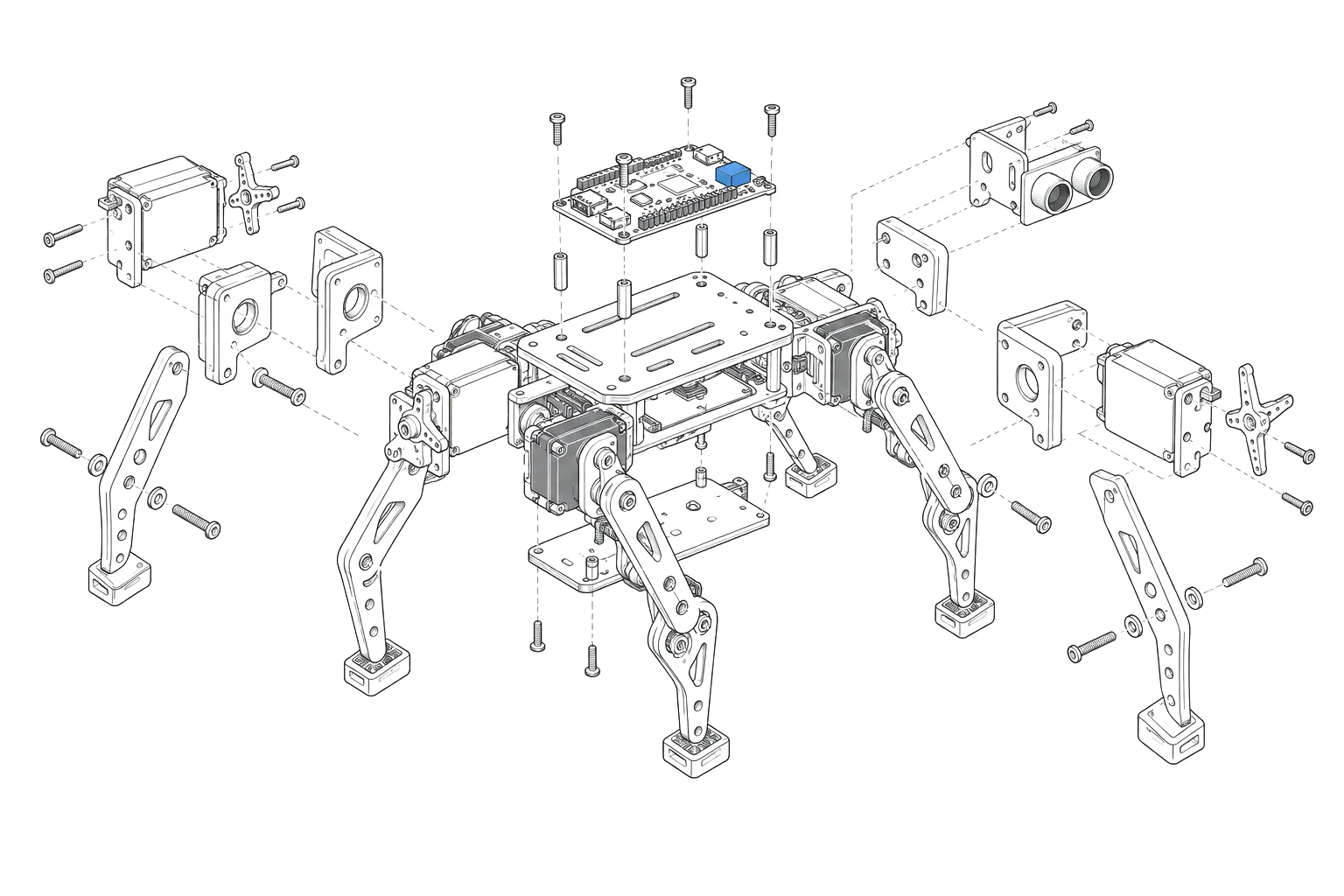
An open-source, 3 kg robot dog with brushless motors, a fisheye camera, a screen face and a microphone, designed to teach motor control and reinforcement learning. Stanford's CS 123 students build one from a starter kit each spring. It is a teaching and research platform you assemble yourself, not a finished pet.
- Price
- $2,000Shipped The project says you can build Pupper v3 yourself for about $2,000. Reseller AIFITLAB sells a parts kit from $1,450 that excludes printed parts, battery and controller.
- Status
- ShippingShipped Open-source build; v3 is the platform for Stanford's CS 123 course
- Height
- 0.2 m
- Weight
- 3 kg
- Payload
- —
- Runtime
- —
- Top speed
- —
- Degrees of freedom
- 12
- Compute
- Raspberry Pi 5 (8 GB) with M.2 slot for an AI accelerator
- Made in
- United States
A dash means the maker has not published it. Values with a label are claims, not measurements.
Trust and legalWhat these mean
Does a remote human drive it?
Partly
Walks under gamepad control; students add learned locomotion, object tracking and voice responses.
US FCC
Not applicable
A self-built open-source design with no whole-robot FCC authorization; radios are in the Raspberry Pi. At 3 kg it exceeds the 2 kg mobile-robot threshold, but the July 2026 rule does not address hobbyist kits and it is designed in the US.
Status history2 dated events
- Shipping
Stanford's CS 123, in its third year, has students build AI-powered Pupper robots from a starter kit Stanford students build tiny AI-powered robot dog from basic kit (Interesting Engineering)
- Shipping
Stanford Pupper paper describes an open-source agile quadruped buildable in under 8 hours for under $2,000 Stanford Pupper: A Low-Cost Agile Quadruped Robot for Benchmarking and Education (arXiv)
PromisesLedger
Sources for specs and status
- Pupper v3 documentation27 Sep 2026
- Pupper v3 technical specifications27 Sep 2026
- Intro robotics students build AI-powered robot dogs from scratch (Stanford Report)Jul 2025
- Pupper V3 parts kit (AIFITLAB)27 Sep 2026
Last updated 27 Sep 2026. Spotted an error? Send a correction.