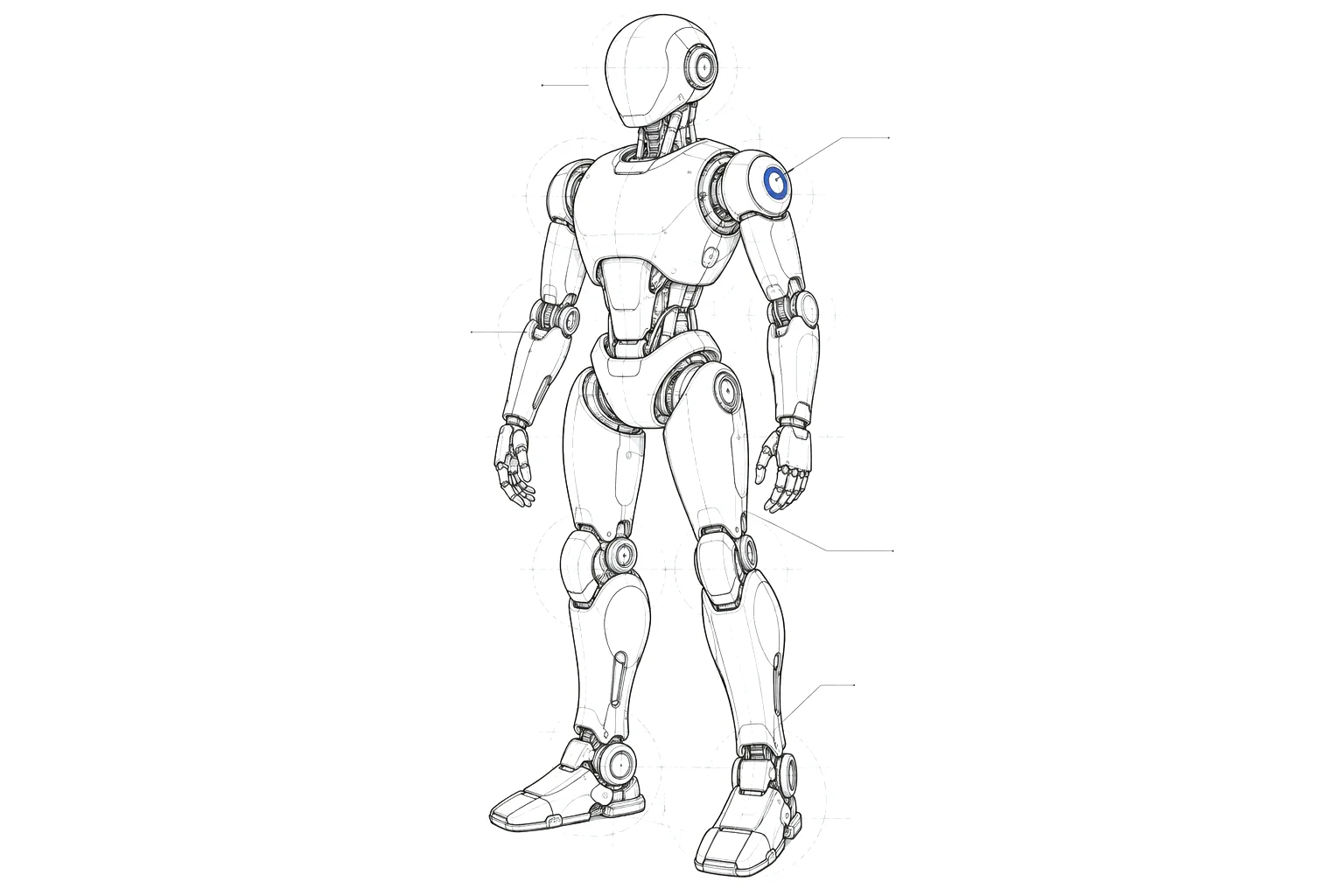
ASUS says Gallop is learning one factory job. The market date is still 2028.
ASUS is testing its first humanoid on motherboard-accessory packing, but its stated partner release is H2 2027 and market availability is a 2028 promise, not a current product launch.
Gallop is scheduled to be released to their partners in the second half of 2027 and hit the market sometime in 2028.CNBC's summary of an interview with ASUS co-CEO S. Y. Hsu
ASUS has introduced Gallop, its first humanoid robot, and says it is being tested on an ASUS production line. That is a real development program with a defined job. It is not a product that customers can order, and it is not evidence of a general-purpose worker.
The short version: Gallop is learning to pack motherboard accessories at one electronics workstation; ASUS has set a target for that job; and the company says partner release is planned for the second half of 2027, with market availability sometime in 2028. Those are company targets, so ShinyMetal labels Gallop a promise.
What they said
ASUS co-CEO S. Y. Hsu told CNBC that Gallop is being tested on the company's production line. CNBC's published summary says the robot is scheduled for release to partners in the second half of 2027 and to reach the market sometime in 2028.
Interesting Engineering's account adds detail about the present trial. Gallop is working at an ASUS group electronics-manufacturing-services factory, where it is learning to pack 15 motherboard accessories. The source says many of those pieces are small, thin, or in flexible transparent bags.
ASUS has set a target of 99.5% task success within 20 seconds for that operation, according to Interesting Engineering. The same report describes a training process that starts with worker demonstrations, then uses simulation and operator guidance through virtual reality. That is a sensible way to train a specific cell. It does not show that the robot can move between arbitrary jobs, recover safely from unexpected conditions, or operate without help.
What is verified
Two things are clear from the sources we opened. First, ASUS has publicly named Gallop and says it is testing the humanoid on its own production line. Second, the company has identified a specific task: motherboard-accessory packing in a human-designed workstation.
That is more concrete than a render or a stage routine. A repetitive packaging station gives a robot stable parts, a repeatable layout, and a measurable completion test. The reported 20-second goal also gives observers a future benchmark: ASUS can eventually show whether Gallop meets it over a meaningful number of runs, rather than only in edited clips.
The sources do not establish the robot's current success rate. The 99.5% figure is ASUS's target, not a demonstrated result. Nor do they provide a public price, technical specification sheet, production volume, customer list, safety certification, or evidence of a third-party deployment.
What is missing
The calendar is the biggest gap. A partner release in H2 2027 is more than a year away. A market date in 2028 is farther still. ASUS has not said who the partners will be, how many machines it expects to make, or whether the market date means a broad commercial sale, a limited enterprise program, or something else.
There is also no basis yet for comparing Gallop with an industrial robot already sold for packaging. Traditional automation can be purpose-built around a known carton, feeder, and station. A humanoid has to prove that its flexible body earns its complexity in a work area designed for people.
ASUS's described use of worker video, simulation, and VR-guided practice is useful context, but it also underscores the present maturity level. The company is building task data and refining a workflow. It has not claimed that Gallop arrives trained for a general catalogue of factory work.
What it means for a home robot
Very little, for now. Gallop's announced task is factory packing, not domestic assistance. A workstation has controlled supplies, known lighting, and a defined handoff. A home includes clutter, stairs, pets, changing objects, and people who do not follow a production schedule.
The relevant lesson is narrower. Manipulating small, flexible packaged items is one of the awkward physical problems that household robots will also face. If ASUS eventually publishes repeatable performance data and the robot can handle variation without constant operator intervention, that would be a useful data point about dexterity and training.
Until then, Gallop belongs on the tracker as an announced industrial humanoid with a company schedule. It is not a consumer robot, it is not shipping, and its 2028 date should be read as a promise to revisit rather than a delivery date to rely on.
We labeled this story Promise — The company said it will happen. How we label claims